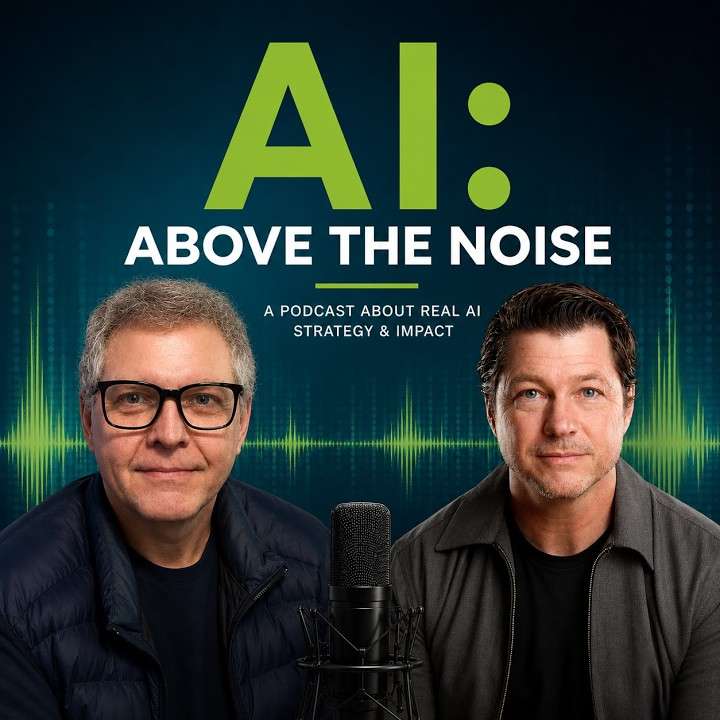
AI: Above the Noise

All Episodes

AI: Above the Noise

Cutting through the noise to find practical AI insights that matter.

Watch on YouTube →
Episode 5
•
July 10, 2026

AI Needs Strategy

As AI becomes an essential part of modern work, success depends on more than choosing the right tool—it requires the right strategy. In this episode of AI: Above the Noise, Scott Dunn and Larry Lawhead discuss how organizations can build thoughtful AI practices that maximize business value, control costs, and empower teams to make smarter decisions.
∨
As organizations continue to invest in artificial intelligence, one question is becoming increasingly important: How do you use AI strategically instead of simply using more AI? In this episode of AI: Above the Noise, Scott Dunn and Larry Lawhead continue their discussion on AI affordability by exploring how organizations can build practical strategies for AI adoption. Rather than defaulting to the most powerful—or most expensive—AI model for every task, they explain why successful teams match the right AI model to the right type of work. Scott and Larry discuss treating AI as another member of the team, assigning specialized roles, making AI costs visible within Agile workflows, and creating working agreements that help teams balance efficiency, quality, and cost. They also explore the importance of focusing on business value, understanding when premium AI capabilities are worth the investment, and avoiding unnecessary spending on routine tasks. Whether you’re leading an Agile team, managing AI initiatives, or simply looking to improve the way your organization uses AI, this episode offers practical guidance for building an AI strategy that delivers measurable value without unnecessary complexity or expense.
Episode 4
•
July 7, 2026

AI Isn’t Saving You Money

As AI becomes a permanent part of the workplace, understanding its true cost is more important than ever. In this episode of AI: Above the Noise, Scott Dunn and Larry Lawhead explore AI affordability, showing how organizations can balance performance, cost, and quality while building smarter AI workflows that scale.
∨
AI adoption is accelerating—but so are the costs. In this episode of AI: Above the Noise, Scott Dunn and Larry Lawhead take a practical look at AI affordability and what organizations need to consider as AI moves from experimentation to everyday business use. They discuss why the era of “free AI” is quickly disappearing, how different AI models vary in cost and capability, and why selecting the right model for the right task can significantly reduce expenses without sacrificing results. The conversation also explores the growing role of AI agents, including how organizations can assign specialized roles to different agents and even use one AI to verify the work of another, improving accuracy while reducing hallucinations. Throughout the episode, Scott and Larry emphasize that successful AI adoption isn’t just about choosing the most powerful model—it’s about building thoughtful, cost-effective systems that empower teams while maximizing return on investment. Whether you’re leading an AI initiative or simply looking to make smarter decisions about AI in your daily work, this episode offers practical insights you can apply immediately.
Episode 3
•
June 3, 2026

AI Found Its Own Bias

Can AI recognize its own bias? Scott and Larry explore how bias emerges in AI systems, why data quality matters more than most organizations realize, and what happens when an AI model identifies and explains its own assumptions. A practical discussion on trust, transparency, and the human role in AI decision-making.
∨
Can AI recognize its own bias? Scott and Larry explore how bias emerges in AI systems, why data quality matters more than most organizations realize, and what happens when an AI model identifies and explains its own assumptions. A practical discussion on trust, transparency, and the human role in AI decision-making.

Prompts from this episode

Generate persona dataset for classroom exercise

This is an exercise I'm putting together for learning objective ID 3.3.2 of our AI for Product Owners course. The goal of this exercise is to discover insights Product Owners can gain by using AI to create a wide range of personas by slightly tweaking the persona criteria. Using the list of chronic conditions I've just given you, create an Excel document containing 200 records of patients from 50–110 years of age. Here are the column names: Chronic Condition, Age, Gender, Risk Factors, Brief health history of non-chronic conditions, Recommended Treatment.

Further Info

Claude's Warning
One other thing worth flagging given your learning objective: a key insight for Product Owners is that AI-generated personas can quietly encode bias or unrealistic combinations (e.g., a 52-year-old with advanced dementia, or treatment recommendations that don't match the demographic). You may want to leave some of those in deliberately so learners can spot them.

Leave bias in and flag it

Leave them in and flag any you notice when you generate the file.

Further Info

Claude's Answer
Good call — that's actually pedagogically valuable. Building the file with ~28 flagged records covering all four bias types, with a subtle indicator (a small marker in a "Notes" column) that learners can find on careful review.

Exercise Overview — Learning objective, dataset description, the heads-up to learners that errors are seeded in, and six discussion questions.

Patient Personas — 200 records with the columns you requested, plus an ID column for easy reference and a Notes column where the subtle marker (※) appears on flagged rows.

Instructor Key — All 28 flagged rows by ID, categorized into four bias types (Age Condition, Treatment Demo, Gender Bias, Implausible), what's wrong with each, and a discussion prompt tied to each category.

A few notes on what's seeded in:
  • 6 age-condition mismatches — e.g., a 51-year-old labeled "advanced age," a male listed as postmenopausal
  • 7 treatment-demographic mismatches — e.g., a 108-year-old prescribed bypass surgery evaluation, a 95-year-old dementia patient told to self-manage insulin
  • 6 gender-biased records — e.g., a female cardiac patient told her symptoms are "likely anxiety-related," a male osteoporosis patient dismissed as "rare in men"
  • 9 implausibility/contradiction cases — e.g., a patient with all 10 conditions, "smoking cessation" prescribed for a documented non-smoker, a male with "history of gestational diabetes"

Identify and explain bias in a specific record

Attached is a document you created for LO 3.3.2 Crafting User Personas. You indicated the second record "Alzheimer's/Dementia; Osteoporosis; Heart Disease; COPD" contains an AI bias. Explain what bias that is and how an AI agent could have come to that bias conclusion.

Further Info

Claude's Answer
The persona is a 52-year-old female carrying four chronic conditions that almost never co-occur at that age: Alzheimer's/Dementia, Osteoporosis, Heart Disease, and COPD. The risk factors compound the problem — "advanced age" and "postmenopausal status" are listed for a 52-year-old, which is medically incoherent.

The specific bias: "elderly chronic-disease patient" stereotype projection

The AI learned a strong statistical association in its training data: multi-morbidity (especially dementia + osteoporosis + heart disease + COPD) clusters in patients 75+. When asked to generate a persona with that condition cluster, the AI reached for the demographic template it associates with that cluster — the elderly patient archetype — and applied those descriptors without checking them against the age field it had already populated. This is sometimes called representational bias or stereotype amplification: the model doesn't just reflect the correlation, it over-applies it, treating "has these conditions" as functionally equivalent to "is elderly."

How an AI agent could arrive at this conclusion

  1. Co-occurrence learning without causal reasoning. Large language models learn that certain tokens travel together. "Alzheimer's," "osteoporosis," "COPD," and "heart disease" appear in training corpora alongside words like "elderly," "advanced age," "postmenopausal," "geriatric." The model samples from that joint distribution without knowing that age is a cause of these conditions clustering.
  2. No internal consistency checking across fields. The model generates fields as a sequence of tokens, not as a relational record. It populated Age=52 early, then generated conditions and risk factors independently, without going back to verify compatibility. There's no built-in constraint that says "if age < 60, do not write 'advanced age.'"
  3. Training data skew toward the typical case. Medical literature disproportionately describes these conditions in their typical demographic (older adults). Atypical early-onset cases are underrepresented, so the model falls back on the elderly template by default.
  4. Prompt under-specification amplifies the prior. Without being told to generate realistic age-condition combinations, the model defaults to its strongest prior — which for this condition cluster is "elderly."

Why this matters for a Product Owner

If a PO uses this persona unexamined to inform a product decision — say, designing a care-coordination app — they could build features around assumptions (large fonts for low vision, caregiver-mediated workflows, simplified language for cognitive support) that may genuinely fit an 85-year-old but completely miss a real 52-year-old early-onset patient who is still working, tech-fluent, and managing their own care. The bias isn't just wrong in the dataset — it would propagate into product decisions that exclude or mis-serve real users.
Episode 2
•
June 1, 2026

Prompt Engineering is Dead?

Is prompt engineering dead — or is it the skill every professional actually needs to master? Scott and Larry cut through the debate, share real-world examples from their own AI experiments, and make the case for why knowing how to talk to your AI agent is becoming as fundamental as knowing how to type.
∨
In this episode, Scott and Larry tackle the hot topic of whether the “prompt engineer” role has run its course — and why the answer is more nuanced than the headlines suggest. They explore why prompt engineering isn’t a job title to debate, but a core competency every team member needs to develop. Drawing on real examples — including Claude making sense of inconsistent data across multiple spreadsheets — they discuss how clean data, the right mindset, and leaning into AI consistently matters more than perfecting any single prompt. They also touch on how AI models are rapidly getting better at inferring intent, why your data quality might be your biggest bottleneck, and how the goal was never the prompt — it was always the value. Plus, Larry shares insights from Co-Intelligence by Ethan Mollick and why treating AI as a true partner changes everything. Key Takeaways: Prompt engineering is a team skill, not just a job title Your data quality may matter more than your prompts Today is the worst AI will ever be — lean in now Identify your team’s prompt champions and let them teach others
Episode 1
•
May 13, 2026

The AI Productivity Trap Nobody Talks About

Everyone talks about AI making teams faster. Scott and Larry unpack what happens after the productivity boost — and the hidden human costs leaders need to watch for.
∨
AI makes teams faster — but faster isn’t always better. This episode unpacks the hidden human side of AI transformation: why AI amplifies company culture, the danger of efficient burnout, how AI can destroy psychological safety if misused, and how great teams are adopting AI without losing trust and relationships.

Prompts from this episode

Blocker pattern analysis

Look across our Jira issues closed in the last 90 days and identify recurring blocker patterns. Which teams, issue types, or workflow stages see blockers most frequently? Don't list the individual issues. Tell me what the underlying systemic causes appear to be and where we should focus process improvements.

Documentation gap finder

Based on search activity in Confluence and questions asked in Rovo Chat over the last 60 days, which topics are people searching for most often without finding good answers? Identify where our documentation has systemic gaps and suggest which Confluence spaces or pages most urgently need to be created or updated.

Hidden dependency mapper

Review active epics and in-progress work across our projects and identify where teams have undocumented dependencies on each other, work that's likely to collide or block without a coordination plan. What are the highest risk handoff points, and what conversations or decisions are we missing?

Meeting audit

Audit the last 30 days of our Confluence pages, Jira comments, project updates. Identify which recurring meetings, status updates or check-ins are covering information that could be automated or self-served through better documentation or dashboards. Give me a specific list of meetings or rituals we should eliminate or replace with asynchronous AI-driven updates, and tell me what would free up for deeper strategic work.

Execution vs strategy sorter

Review our active roadmap and backlog. Separate the work into two buckets: execution tasks that could be largely driven by AI agents or automation, and decisions that genuinely require human strategic judgment, creativity, or relationship capital. For bucket one, recommend which automations could absorb that work. For bucket two, help me frame the open strategic questions my team should be spending more time on.

Roadmap trend spotter

Based on our project history, completed epics, and team velocity over the past two quarters, identify trends our leadership team should be paying attention to strategically. Where are we consistently underestimating scope? Where are we over-investing relative to business impact? What does the data suggest we should be doing differently in how we set priorities or build our roadmap for next year?